From Broadcast Schedules to the On-Demand Queue
From broadcast schedules to the on-demand queue, see how control over timing reshapes a viewing session and choose a format that suits your evening.
The common mistake is to treat on-demand viewing as a broadcast schedule with the clock removed. That misses what changed: a timetable once shaped a session from outside, while an on-demand queue asks the viewer to shape it from within. The shift from broadcast schedules to the on-demand queue offers more control over timing, but it also transfers the small decisions that once belonged to the channel.
The timetable’s shape
In scheduled broadcasting, a programme arrived at a set time and occupied a place in a larger sequence. A viewer might tune in for a particular show, stay for what followed, or leave when the evening’s available choices stopped fitting. The schedule supplied boundaries whether or not anyone had requested them.
Those boundaries did more than restrict choice. They gave a viewing session an external rhythm: a start time, a transition between programmes and, eventually, an endpoint. A programme’s position could matter as much as its subject. The next item was already waiting, so continuing required little more than staying put.
This arrangement suited viewers who wanted a settled evening with few decisions. It also suited casual viewing: a person could join whatever was on, without first deciding exactly what to watch. The trade-off was limited control. Arriving late, missing a programme or wanting to pause could disrupt the intended sequence.
The schedule also made stopping relatively plain. A broadcast ended, the next item began, or the viewer switched off. That did not prevent a long evening in front of the screen; it simply placed the boundary somewhere outside the viewer’s immediate choice.
The queue’s shape
On-demand services reverse the arrangement. A viewer chooses a programme and decides when to begin. Episodes and saved titles can be assembled into a queue, and playback can often be paused or resumed. Instead of fitting an evening around an announced sequence, the sequence is fitted around an evening.
This flexibility suits people with irregular routines, viewers who prefer to watch a programme in one sitting, and anyone who wants to return to a story at a chosen time. It also makes deliberate selection possible: a film can be chosen for the amount of attention available, rather than accepted because it happens to be airing.
But the queue does not merely remove the timetable. It relocates its work. Someone must choose a starting point, decide what comes next and recognise when enough is enough. A list can be ready in advance, or it can be assembled at the sofa while the screen patiently offers another row. The second method is often less efficient, though it has a long tradition of surviving perfectly well.
On-demand sessions can therefore feel more intentional or more open-ended. The viewer has control over the clock, but a queue can make continuation effortless. When one episode ends, the next may be a selection rather than an appointment, yet it still creates momentum.
Three viewing patterns
These are not competing technologies so much as different ways to organise an evening. Each places the burden of timing and selection in a different place.
- Scheduled viewing: A channel sets the time and sequence. It suits viewers who like a shared, predictable rhythm or prefer not to choose every programme. It is less suitable when availability, pauses or late arrival matter.
- A single on-demand choice: The viewer selects one film or programme and treats it as the session. It suits viewers who want control over the start and a clear destination, without planning a long queue. It works best when the choice is made before browsing becomes the evening’s main activity.
- A prepared queue: The viewer chooses several items in advance and watches in sequence. It suits viewers who want continuity but also want to set their own pace. It is less suited to an evening that needs a definite endpoint unless the queue is deliberately kept short.
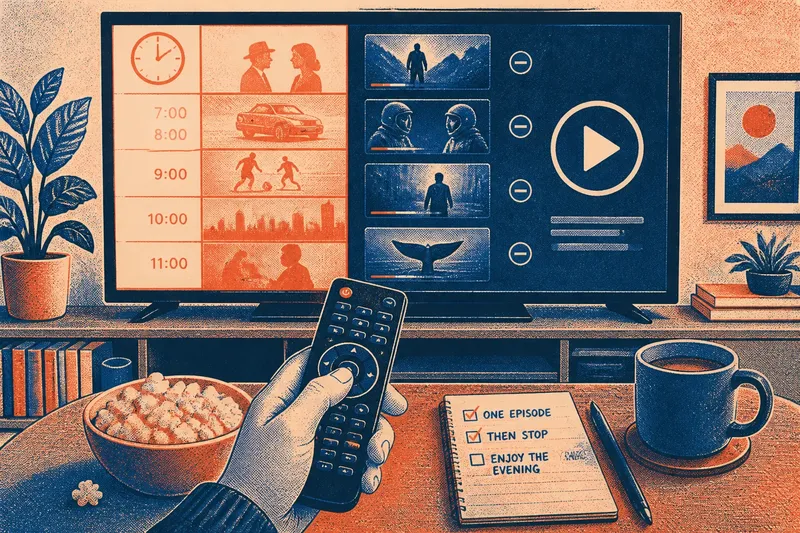
Imagine you have an unsettled evening and want to watch one episode without drifting into a long session. You choose the programme before sitting down, leave the next episode out of the queue and decide that the session ends with this one. The observable result is a session with a chosen start and a visible stopping point; the programme itself need not change.
Where control moves
Broadcasting gives the channel control over timing and sequence; the viewer mainly decides whether to join. On-demand viewing gives the viewer control over timing, but selection and stopping become part of the session’s design. Neither arrangement is simply more relaxed. A timetable can spare someone repeated choices, while a queue can spare someone a fixed appointment.
There is also a difference between choosing a programme and choosing a session. The first is a question of content. The second concerns how much time, attention and continuity the viewer wants to give it. A short episode, a self-contained film and a run of connected episodes invite different kinds of commitment, even when all are available from the same service.
For a casual evening, scheduled viewing may be appealing precisely because it does not ask for a plan. For a particular title, a single on-demand choice keeps attention on that selection. For a deliberate run of related episodes, a prepared queue removes repeated browsing, though it can also make stopping less obvious. The useful comparison is not freedom against constraint, but which decisions the viewer wants the service to make and which to keep.
Choosing a session?
Is scheduled viewing better for casual watching?
It can be, if the appeal is to turn on a channel and accept its sequence rather than choose a title. The schedule supplies a ready-made session, though it offers less flexibility about when to join or leave.
Does on-demand viewing always mean more control?
It gives the viewer more control over starting time and often over pauses, but it also hands over decisions about selection and stopping. A long queue can make continuation easy without making the session feel more deliberate.
How can I keep an on-demand session bounded?
Choose the title and stopping point before playback, then avoid adding more items simply because they are available. A single programme or a deliberately limited queue makes the intended shape easier to see.
Which approach suits an irregular routine?
On-demand viewing usually fits more easily because the viewer can begin at a chosen time and return later when playback options allow. Scheduled viewing may still suit someone who enjoys a fixed ritual and can arrange the evening around it.
What need not be managed
Not every session needs a curated queue, a theme or a carefully optimised stopping rule. If the intention is simply to watch whatever is already on, browsing for the perfect arrangement can add work without improving the evening. The timetable’s old virtue was not elegance; it was that someone else had already made the next choice.
The change from broadcast schedules to the on-demand queue is therefore less a story of one format replacing another than a transfer of control over time. Choose scheduled viewing when a ready-made rhythm is useful, one on-demand title when a clear destination matters, and a prepared queue when continuity is the point. The small but useful question is whether you want the next programme decided before the session begins, or left for the person sitting in front of the screen.